From Routine Cleanup to Suspected Cover-Up? Epstein Jail Shredding Claims Resurface in File Releases
Washington/Miami — Revelations from long-buried FBI records have cast fresh doubt on the aftermath of Jeffrey Epstein’s 2019 death, highlighting reports of extensive document destruction at the Metropolitan Correctional Center just days after the financier was found hanged in his cell.
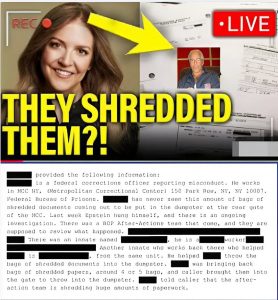
The incident, detailed in Justice Department files analysed by the Miami Herald and released in batches through 2026, centres on a 16 August 2019 call to the FBI from an MCC corrections officer. The officer described witnessing what he termed an extraordinary volume of shredded paperwork being carted to the prison’s rear dumpster—material he believed warranted scrutiny given the timing and the presence of a BOP After-Action Team examining Epstein’s suicide.
Epstein died early on 10 August 2019, shortly after being removed from suicide watch despite a prior apparent attempt. Guards assigned to monitor him failed to perform required rounds, and surveillance footage later proved incomplete. The official autopsy confirmed suicide, and a comprehensive 2023 inspector general review blamed institutional breakdowns rather than foul play.
Yet the shredding accounts add another layer of unease. An inmate reportedly assisted in moving “bags” and “bales” of shredded documents on 15 and 16 August, telling staff the After-Action Team was “shredding everything.” A back-gate officer documented similar observations in a memo, noting the unusual quantity and expressing unease that destruction was occurring amid federal inquiries by the FBI and prosecutors.
The BOP maintains that administrative records unrelated to investigations are routinely destroyed to comply with retention rules. However, the officer’s decision to contact the FBI’s threat centre—rather than internal channels—suggests genuine concern over potential impropriety. “I believe that this conduct may be inappropriate for [an] investigative team to be shredding paperwork related to the investigation,” one contemporaneous note reportedly read.
No public evidence has surfaced confirming that evidentiary materials were targeted. Two guards on duty the night Epstein died told investigators years later that they had not destroyed any paperwork connected to him. The FBI intake from 2019 appears to have led nowhere in terms of charges or major findings, though the full scope of any follow-up remains unclear.
The timing of the reports’ re-emergence—amid renewed document releases and political debates over transparency—has amplified speculation. Attorney General Pam Bondi has referenced thousands of additional Epstein-related pages, while critics accuse agencies of selective disclosure. Victims’ lawyers and congressional overseers have pressed for clarity on whether any records pertinent to Epstein’s network were lost.
Scholars of criminal justice point to broader context: federal prisons routinely manage vast quantities of paper, and post-incident reviews often involve purging non-essential files. “The optics are terrible, but routine shredding doesn’t automatically equal conspiracy,” noted criminologist Alex Friedmann of Prison Legal News. “What matters is whether chain-of-custody protocols were followed for anything tied to the death investigation.”
Still, the episode underscores persistent distrust in the handling of Epstein’s case—from camera malfunctions and staffing lapses to delayed file releases. Advocacy groups continue to call for independent audits of remaining materials, arguing that full transparency is the only way to close one of the most polarising chapters in recent US legal history.
As more pages from the Epstein files enter the public domain, the shredded-document reports serve as a reminder: even in the absence of definiti
Leave a Reply