AOC Raises Blackmail Fears Over Epstein Files as Trump Faces Renewed Scrutiny
Washington — Representative Alexandria Ocasio-Cortez delivered a pointed warning on Capitol Hill this week, asserting that President Donald Trump’s documented ties to Jeffrey Epstein leave him potentially vulnerable to foreign blackmail — a risk she said could already be influencing high-stakes U.S. decisions. The New York Democrat’s comments, made during exchanges with reporters and amplified on social media, come amid the slow, contentious release of millions of pages related to Epstein’s sex-trafficking investigation under the Epstein Files Transparency Act, signed into law by Trump himself in November 2025.
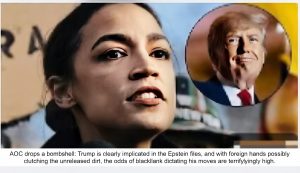
Ocasio-Cortez stated that publicly available portions of the files show Trump is “absolutely implicated” through social and travel connections to Epstein, a convicted sex offender who died in custody in 2019. She argued that unreleased or heavily redacted materials — which she described as the majority of the archive — could contain compromising details. “If there’s a foreign actor out there that has more access to the Epstein files than the United States Congress, then we do not know who is compromised, the extent to which they are compromised, and the extent to which blackmail could play a role,” she told reporters following a March 2026 briefing.
The remarks echo broader Democratic criticism of the Justice Department’s handling of the files under Attorney General Pam Bondi. Multiple batches released since December 2025 — totaling over 3.5 million pages by early March — have drawn bipartisan frustration for extensive redactions and delays. Democrats, including Senate Minority Leader Chuck Schumer and House Oversight members, have accused the administration of selective disclosure, while some Republicans have defended the process as thorough and protective of privacy. A recent closed-door briefing saw several Democrats walk out in protest, demanding Bondi testify under oath.
Trump’s association with Epstein dates to the 1990s and early 2000s, including flights on Epstein’s plane and social events at Mar-a-Lago. Trump has repeatedly distanced himself, calling Epstein a “fixture in Palm Beach” but claiming he banned him from the property after learning of his behavior. No criminal charges have been filed against Trump in connection with Epstein’s crimes, and released files to date contain no direct evidence of wrongdoing beyond known associations. Still, Ocasio-Cortez highlighted what she called a pattern: spikes in foreign policy action coinciding with Epstein file revelations.
She pointed to the recent U.S.-Israeli airstrikes on Iranian targets — which have escalated regional tensions and drawn global condemnation — as potentially linked. “Every time he’s done that, it has been consistent with a spike or a revelation in what is happening with the Epstein files,” she said. “If the Epstein files have such a hold on President Trump and this administration that they are willing to plunge us and risk world war in order to save themselves politically, that is the definition of someone that cannot make objective decisions for the American people.”
White House officials dismissed the claims as partisan speculation. A spokesperson described Ocasio-Cortez’s statements as “reckless” and reiterated that the administration has complied with the Transparency Act, releasing files in phases after review for national security and victim privacy. Trump himself has called ongoing scrutiny a “hoax” reminiscent of past Russia investigations.
National security experts offered measured caution. “The theoretical risk of foreign intelligence services acquiring compromising material on any public figure is real, particularly in an era of digital leaks and espionage,” said Suzanne Spaulding, former under secretary at the Department of Homeland Security. “But without concrete evidence of specific blackmail or foreign possession of unreleased files, these remain hypotheticals.” Intelligence community assessments have not publicly confirmed any foreign actor holding Epstein-related kompromat on U.S. officials.
The controversy unfolds against a backdrop of heightened U.S.-Iran tensions following strikes that killed senior Iranian figures, including Supreme Leader Ali Khamenei. Oil prices have surged, and European allies have urged de-escalation. Critics argue the timing distracts from domestic issues, including the Epstein files, while supporters frame the military action as necessary deterrence.
For now, Ocasio-Cortez’s intervention has intensified calls for full, unredacted disclosure. Bipartisan figures, including some Republicans who backed the Transparency Act, have pressed for clarity on remaining documents. Whether her blackmail warning proves prescient or politically charged rhetoric, it underscores the enduring shadow Epstein’s network casts over American politics — and the high stakes when personal history intersects with global crises.
Leave a Reply