For more than twenty years, Darren Indyke operated as Jeffrey Epstein’s personal attorney and all-purpose fixer, managing legal affairs, corporate structures, and intricate financial transactions. Financial records reveal that between 2011 and 2019, Epstein and his entities paid Indyke over $16 million in fees, supplemented by millions more in loans that were ultimately forgiven. In Epstein’s final will, signed just days before his death in 2019, Indyke was named co-executor of the estate and stood to receive a $50 million bequest, one of the largest individual gifts outlined in the document.
What has drawn particular scrutiny are the repeated large cash withdrawals Indyke facilitated on Epstein’s behalf. Court filings and bank reports describe a pattern stretching from 2013 to 2017 in which Indyke cashed checks—often $7,500 at a time, just below certain reporting thresholds—dozens of times from Epstein’s accounts. These transactions, sometimes combined with smaller withdrawals from Indyke’s own business account, reportedly supplied Epstein with stacks of cash carried in a distinctive black bag. Over two years, similar structured withdrawals occurred 45 times, while additional ATM transactions near Indyke’s office added up to nearly $100,000 in smaller increments.
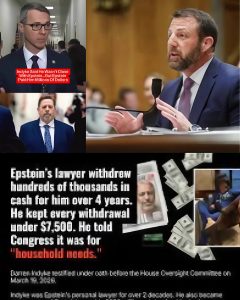
During his March 2026 testimony before the House Oversight Committee, Indyke downplayed any suggestion of impropriety. He insisted the cash was needed for Epstein’s lavish lifestyle—funding maintenance and daily operations across multiple multimillion-dollar properties in New York, Florida, New Mexico, Paris, and the U.S. Virgin Islands, as well as gratuities, meals, and private jet expenses. Epstein had faced difficulties obtaining credit cards from major banks, Indyke explained, making cash a practical necessity. He denied deliberately structuring withdrawals to evade federal reporting requirements, claiming the bank was fully aware of the account holder’s identity and that he was simply complying with internal bank limits.
Despite his central role in Epstein’s financial machinery, Indyke told lawmakers he had “no knowledge whatsoever” of any criminal activities. He described the attorney-client relationship as strictly professional, with no socializing outside of work and no insight into Epstein’s private life “behind closed doors.” Had he known of any wrongdoing, Indyke asserted, he would have severed ties immediately.
The disconnect has raised eyebrows among investigators and observers alike. How could a lawyer so deeply embedded—handling millions in payments and personally delivering bags of cash—claim near-total ignorance? Indyke maintains that his duties were limited to legitimate business and household needs, and that no accusers have ever directly implicated him in misconduct. As co-executor, he continues to oversee the estate’s remaining assets, now significantly diminished after massive payouts to claimants and settlements.
Indyke’s account fits a broader pattern in the Epstein saga: longtime associates who profited handsomely while professing limited visibility. The cash flows, the black bag deliveries, and the enormous compensation tell one story. His testimony offers another—one of professional detachment amid extraordinary access and reward. As congressional scrutiny deepens and the estate’s final accounting proceeds, the question lingers: where does zealous representation end and convenient blindness begin?
Leave a Reply