Behind the cold bars of a Florida jail cell in July 2008, Jeffrey Epstein had just begun serving time for sex crimes with a minor—when, shockingly, his own Zorro Trust hit the jackpot. The very next day, a Powerball ticket sold in tiny Altus, Oklahoma, won an $85 million prize. Weeks later, while Epstein sat locked up, the same shadowy Zorro Trust—the identical legal entity he used to control his vast New Mexico ranch—quietly claimed the winnings and walked away with a $29.3 million lump-sum payout after taxes.
The timing felt too perfect, the anonymity too convenient. Now, fresh DOJ files explicitly link “Zorro Trust (belonging to Epstein)” to the massive win, with his ranch manager reportedly stepping in to handle the claim.
Was this insane luck… or something far more calculated?
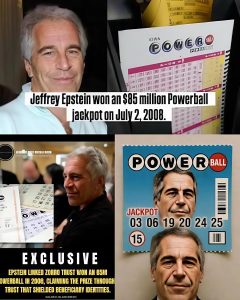
In July 2008, Jeffrey Epstein began serving a controversial jail sentence in Florida after pleading guilty to charges involving sex crimes with a minor. While the case had already attracted national attention because of the unusually lenient plea deal he received, an extraordinary financial twist soon followed—one that would remain largely unnoticed for years.
Just as Epstein started his sentence, a Powerball ticket sold in the small town of Altus, Oklahoma, hit an $85 million jackpot. Weeks later, the prize was quietly claimed by a mysterious legal entity known as the Zorro Trust. Rather than taking the full payout over time, the trust chose the lump-sum option, collecting approximately $29.3 million after taxes.
At the time, the claim did not spark widespread suspicion. In many U.S. states, lottery winners are allowed to use trusts or other legal entities to collect prizes in order to protect their privacy. Oklahoma law permitted such arrangements, meaning the public had little visibility into who actually controlled the trust behind the winning ticket.
Years later, however, the story has resurfaced following the release of additional documents related to Epstein’s financial network. Among the newly discussed materials are references connecting the Zorro Trust directly to Epstein. One document reportedly describes the entity as “Zorro Trust (belonging to Epstein),” raising new questions about the true beneficiary of the lottery windfall.
The Zorro Trust had already appeared in records linked to Epstein’s financial dealings. Notably, the same entity was used in the acquisition and control of his large ranch property in New Mexico, a secluded estate that later became a focal point in investigations into his activities and business operations. Because trusts can obscure ownership details, they are often used to separate individuals from direct asset holdings.
According to reports connected to the recently surfaced files, Epstein’s ranch manager may have been involved in handling the lottery claim on behalf of the trust. If accurate, that detail would suggest that someone within Epstein’s inner circle helped finalize the process while he was incarcerated.
What makes the situation particularly intriguing is the timing. The winning ticket appeared just one day after Epstein entered jail, and the prize was ultimately collected while he remained behind bars. For some observers, the sequence of events feels almost cinematic—an imprisoned financier seemingly linked to a multimillion-dollar jackpot unfolding far from his cell.
Still, no public investigation has concluded that anything improper occurred in the lottery process itself. Powerball drawings are conducted under strict oversight, and winning tickets must pass multiple verification steps before prizes are paid out. From a purely procedural standpoint, a trust claiming a jackpot is not unusual.
The lingering questions therefore center less on the lottery mechanics and more on the financial structures surrounding Epstein’s wealth. Trusts like the Zorro Trust can hold assets, conduct transactions, and operate independently from the individuals who benefit from them, making it difficult to trace financial activity without access to internal records.
For critics and investigators studying Epstein’s complex financial network, the jackpot adds another puzzle piece. Was the win simply an extraordinary coincidence during an already dramatic moment in his life? Or does it reflect a deeper layer of financial maneuvering hidden behind legal entities?
Nearly two decades later, the Powerball ticket from Altus remains one of the more unusual footnotes in the sprawling story of Jeffrey Epstein. The documents may hint at connections, but the full explanation—whether luck, coincidence, or something more strategic—has yet to be definitively proven.
Leave a Reply