A woman stepped out of a luxury boutique clutching a sleek black Prada handbag, her heart racing with excitement over the glamorous world Epstein had promised her—only to realize too late that the gifts and name-dropping were part of a calculated web of control.
Jeffrey Epstein masterfully weaponized high-end fashion to lure women into his orbit and keep them silent. From posing as a Victoria’s Secret modeling scout to dangle dreams of runway success, he extended his reach to other elite brands. Court files and emails reveal he showered associates and potential victims with expensive gifts: a Goyard purse for one contact, a Prada tote approved personally by him for his publicist, along with other luxury items designed to create obligation and dependency.
While victims chased the allure of these prestigious names, Epstein allegedly used the glamour of Victoria’s Secret, Prada, Goyard and more to build trust, isolate, and ultimately silence those who entered his circle.
The full extent of how luxury fashion became a tool in his alleged trafficking network continues to shock—and raises unsettling questions about complicity in the industry’s glittering facade.
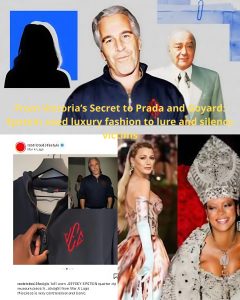
A polished storefront, a designer logo, the quiet thrill of stepping into a world defined by exclusivity—luxury fashion has long sold more than products. It sells access, aspiration, and identity. For some, however, that allure became entangled with something far darker, as the name Jeffrey Epstein emerged at the center of disturbing allegations about manipulation and control.
Epstein understood the symbolic power of elite brands. By presenting himself as a gatekeeper to opportunity—particularly through his claimed connections to Victoria’s Secret—he was able to cultivate trust and credibility. The promise of entry into an exclusive world, especially one associated with global recognition and success, proved persuasive. For those unfamiliar with the inner workings of the fashion industry, such claims could feel both believable and life-changing.
Beyond words, Epstein reportedly used material incentives to reinforce his influence. Court documents and communications suggest he distributed high-end gifts, including items from Prada and Goyard. These were not random gestures of generosity. Luxury goods carry social meaning—they signal status, belonging, and favor. In this context, they could also create a subtle sense of obligation, making it harder for recipients to question intentions or disengage.
What makes this pattern particularly unsettling is how effectively it blended into the normal language of wealth and success. In elite circles, gift-giving, networking, and name-dropping are often seen as standard practices. Epstein exploited that ambiguity, operating in a space where influence could be mistaken for opportunity and where skepticism might feel like a missed chance.
The broader implications extend beyond one individual. The situation raises difficult questions about how powerful brands—whether knowingly or not—can be used as tools in systems of manipulation. Companies like Victoria’s Secret built global identities rooted in aspiration, yet those same identities could be appropriated by individuals seeking to gain trust and credibility.
Today, the revelations continue to prompt scrutiny of how influence operates behind the scenes. They challenge assumptions about prestige and highlight the need for greater transparency in industries built on image and access. For many observers, the story serves as a stark reminder: the symbols of luxury and success, while dazzling on the surface, can sometimes mask far more complicated—and troubling—realities beneath.
Leave a Reply