U.S. authorities are reportedly working to identify an anonymous activist responsible for placing a series of provocative “Jeffrey Epstein Walk of Shame” stickers in areas surrounding the White House, sparking debate about protest, public memory, and the lingering shadow of one of the most controversial criminal cases in recent history.
The stickers, which began appearing earlier this week on street signs, utility poles, and pedestrian walkways, feature bold lettering referencing disgraced financier Jeffrey Epstein. Some versions include arrows pointing toward prominent government buildings, while others incorporate imagery meant to evoke public accountability and shame. Their strategic placement near one of the most heavily monitored political zones in the country has raised questions not only about the message itself but also about how the activist managed to install them without immediate detection.
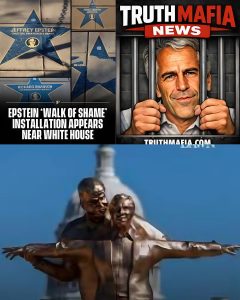
Officials have not publicly identified a suspect but confirmed that security footage from nearby cameras is being reviewed. Given the proximity to the White House, the situation has drawn attention from multiple agencies, including local law enforcement and federal security teams tasked with protecting the area. While the stickers themselves are not considered a direct threat, authorities are treating the case seriously due to the potential implications for security protocols.
The activist’s message appears to tap into ongoing public frustration surrounding Epstein’s network and the perception that many powerful individuals connected to him have not been fully held accountable. Epstein, who died in federal custody in 2019 while awaiting trial on sex trafficking charges, left behind a complex web of associations involving high-profile figures from politics, business, and entertainment. Despite numerous investigations and document releases over the years, public skepticism persists, fueled by unanswered questions and widespread speculation.
Reactions to the stickers have been mixed. Some observers view them as a form of guerrilla activism—an attempt to keep public attention focused on unresolved issues tied to Epstein’s case. Others argue that the tactic crosses a line, particularly given its location and the potential strain on already heightened security measures in the nation’s capital.
Free speech advocates note that political expression, even when provocative, is a protected right under U.S. law, though it can conflict with local ordinances regarding vandalism or unauthorized postings. “There’s a long tradition of using public spaces to make political statements,” said one legal analyst. “The question is where the boundary lies between protected expression and unlawful conduct.”
Meanwhile, cleanup crews have begun removing the stickers as quickly as they appear, suggesting that the individual or group behind the campaign may still be active. The persistence of the postings has added an almost cat-and-mouse dynamic to the situation, drawing further public curiosity and media coverage.
As investigators continue their search, the incident underscores how the Epstein case remains a potent and unresolved symbol in the public consciousness. Whether viewed as an act of defiance or disruption, the “Walk of Shame” stickers have succeeded in reigniting conversation—right at the doorstep of American political power.
Leave a Reply